Bread Without Religion
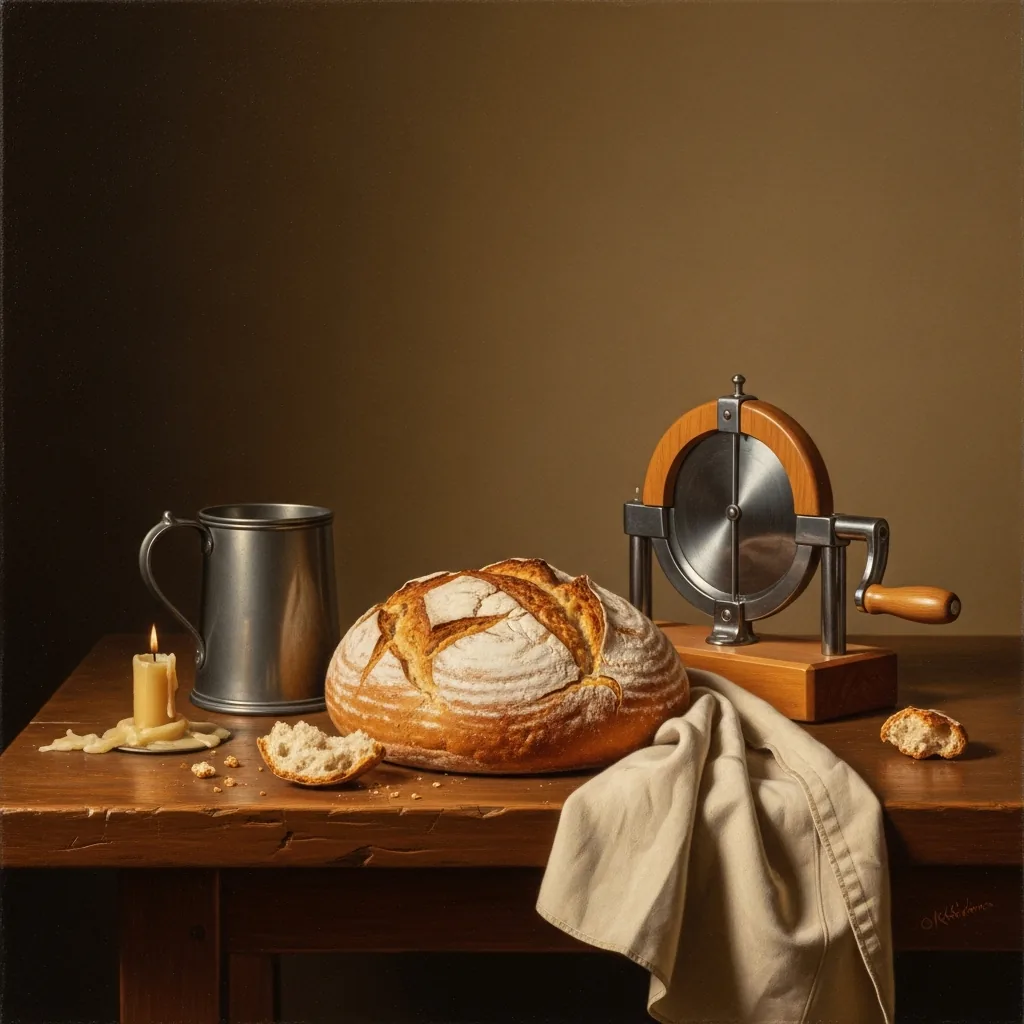
Cover: after Pieter Claesz, Breakfast Still Life with Bread and Roemer — a Friday-bread boule on a dark wooden table — Pieter Claesz's ontbijtje, restrained to its essentials: warm crust, raking window light, no ceremony.
May 2026 — on six years of weekly home bread, with no starter, no schedule, and no rituals
It is Friday evening. There are two loaves of bread cooling on an IKEA pan-holder in my kitchen. One is white. One is volkoren — what a Dutch baker calls wholewheat and what an American tourist might phonetically render as whoooollleee weaaaatt. They will both be quartered with a Swiss manual slicer, dropped into small plastic bags, and stacked in the freezer in front of me. This has been the workflow every Friday for about six years now.
I will tell you exactly how I make them, because that is the point of the post. But the point of making them is something different, so let me start with that.
Why I started
It was 2020. I had a corporate job where IT problems mostly got discussed rather than handled — diagrams produced, decks made, meetings booked to align on the next meeting. Useful work happened in spite of the org chart, not because of it. Then corona arrived and even the bad rituals dried up. The Netherlands locked down. I needed something I could do in a single afternoon that produced an object I could hold and eat, with no Jira ticket attached.
So I made bread. The first one was over-stretched but edible. My wife — who is American but has spent enough time here to develop standards — was actually surprised. Not in the “my husband can bake!” way; in the “after years of supermarket bread you have re-introduced flavour into our house” way. Albert Heijn bread is, by Dutch standards, an embarrassment. It is expensive and it weighs nothing. Chicken with water, bread with air in it.
The first loaf had hooked me on something more durable than flavour: I’d made a thing, and it had worked, and the worst output was still better than the best output of the day job.
Six years later I have not missed many Fridays.
The recipe, because that is what you came for
Per loaf:
- 12 g dried yeast
- 18 g bakery fine salt — bought 5 kg years ago from a baker friend. There is, apparently, something about how your body takes up salt from bread that makes the specific fineness matter; it’s not a taste thing. I just trust the baker on this one.
- 660 g water at ~45 °C
- 1 kg flour — per loaf. One full kilo of white for the white loaf, one full kilo of volkoren for the wholewheat loaf. Two separate batches, two separate bowls, the same Friday.
- a generous glug of olive oil
Steps, with the small things that took me a while to figure out:
- Yeast and salt go on the warm water. Dust the yeast in a slow circular motion over the surface — surface tension keeps it floating, which is what you want, because if it clumps now it is harder to break up later. Tap the side of the plastic bowl and the yeast sinks by itself. Salt goes in next. Yes, the bread purists insist on a particular order — do not let the salt touch the yeast. It makes no difference. I have tried both.
- Stir with a cold metal spoon. A long one — a salad spoon works well. The cold metal stops the dough sticking and the long handle keeps your hands out. I figured this out at loaf number one: I didn’t fancy putting my hands in wet dough on day zero of a new hobby, so I went looking for a tool. The cold-spoon thing is the entire reason I never developed the YouTube baker’s “feel the dough with your hands” religion — I started with the workaround.
- Dump in the kilo of flour. Add the olive oil on top. Mix roughly with the same cold spoon. Three minutes, maximum. Don’t pursue perfection — the dough has hours to sort itself out.
- Cover the bowl with the lid of another Dutch oven (any flat heavy thing works) and put it on top of the stadsverwarming manifold in my utility closet. The manifold sits below the server rack; the closet stratifies — manifold radiating from below, accumulated warm air gathering at the top. The bowl rides on the manifold itself, in a steady ~26 °C glow all year. It is the most reliable proofing chamber I have ever owned, and I did not buy it for that.
- Over the next six to eight hours, wet your hands, pull-and-fold two or three times. Three minutes each round. The dough stays in the bowl; only your hands get wet. You’ll know how many rounds it needs from the feel — not from a stopwatch.
- Around 19:00-20:00, oven to 215 °C, fan on. The Henri (Emile Henry’s stoneware “French oven” — a better Dutch oven than any Dutch oven I have owned) goes in cold. Cold start. No preheat of the vessel. The bread does not care, and saves twenty minutes.
- Now the only tricky bit. Flour the bowl rim, the cutting board, and the inside of the Henri generously. Scoop the wet dough out onto the board in one quick motion, fold three times, flip it over, fold three more. Don’t press the air out — you spent the afternoon putting it in. Transfer to the Henri. Score the top. Dust again. Lid on.
- 45 minutes with the lid on. 5 minutes with the lid off, for the crust. That’s it.
- Cool on the IKEA pan-holder for an hour. The bread speaks during this hour. It contracts and sings small ticks and creaks as it shrinks. This is the best part of Friday.
- Quarter it with the Swiss slicer. Bag the quarters. Freeze. To eat: 600 W microwave for 45 seconds for three quarters (compared to 20 s for the air-bread from Albert Heijn — proof, by physics, that mine has more in it). Take it out while it’s still a touch cold; by the time you’ve cut the cheese it has finished evening out, and it tastes like it just came out of the oven. 900 W is too aggressive — over-microwaving makes the crumb chewy. And no, the Dutch do not toast their bread; that’s an American habit my wife brought with her and I don’t share.
Total active time: maybe twelve minutes across the whole day. Total elapsed time: ten hours, most of them spent doing anything but bread.
Two types of bread makers
There are two types of people who make bread at home. The first type wants to believe. They name their sourdough starter, they consult lunar calendars, they buy a banneton with a linen liner, they post macro photos of crumb structure, they argue about hydration percentages to two decimal places. YouTube is full of these gekkies, half of them performing piety for an audience that has confused theatre with skill. The cruel observation is that they do not, generally, make better bread. They make the same bread as everyone else, and then convince themselves the candle-and-incense version tastes better.
The second type is the way actual bakeries work. If you’ve ever been backstage in a real Dutch bakery at 04:30 — which I have, briefly, with a friend who was opening one — you’ll notice they do not dress up, they do not talk to the dough, they do not have rituals. They have procedures. They are pragmatic, efficient, and intervene only where intervening matters. Everything else is “let it sit.” A professional baker is the opposite of a YouTube baker. He has done this nine thousand times. He knows which steps are load-bearing and which are theatre. Almost everything is theatre.
I tried sourdough once. The starter was too stinky and I did not enjoy the relationship. I am sure mature starters smell less like a sock, but I noticed I was rearranging my schedule around its feeding times and I thought: this is not why I started baking. I went back to a packet of dried yeast and the bread is, demonstrably, just as good. I know exactly one other home baker — also a no-nonsense, no-ritual one — and he uses the same flour mill I do. Neither of us has ever named anything.
The freezer pivot
For the first stretch of years I made four loaves per week. Smaller ones, two oven runs, two flour-dusting sessions, two cleanups, two cutting boards to wash. It worked. But it was the same evening, repeated. And there was always a Wednesday-night sandwich where the bread was on the wrong side of “two days old”.
Then I switched to two 1-kilo loaves — one white, one volkoren — and the Swiss slicer arrived, and the workflow collapsed into one Friday session: two bowls, one (longer) oven run, one cleanup, slice the cooled loaves into quarters, bag the quarters, freeze. The microwave unfreezes a portion the next morning in under a minute. The freezer is a better pause button than the kitchen counter ever was — it stops time on the bread cleanly, and 600 W of microwave un-pauses it. I haven’t invested in a vacuum sealer for the quarters, because simple plastic bags are perfectly acceptable for my weekly consumption.
The volkoren gets a small tweak: I leave its bowl out on the kitchen counter overnight before the bake instead of in the warm closet. Wholewheat wants longer, cooler fermentation — depending on the night’s temperature it’ll be anywhere from eight to twelve hours by the time I bake it. Same recipe, slower clock.
This is not a technique upgrade; the bread is the same. It is a workflow upgrade. The same kind of thing the YouTube bakers will never write a video about, because it isn’t picturesque. It’s just less dishwashing.
Dead flour, shrinking bread
Why bother? After six years of it, the answer is small and unromantic.
It is good to have at least one thing in your week where you put dead flour into a bowl and pull a warm shrinking object out of an oven, and then finish a slice of it with olive oil and salt while the rest is still cooling. The arc is short. The feedback is immediate. The output keeps you fed for the week. None of those things are true of any work I do for money.
The bread does not need me. I need the bread. That is the entire post.
If you have read this far and you are thinking of starting: do not buy the linen banneton. Buy a kilo of flour and an Emile Henry. Skip the starter. Use a packet of yeast. Don’t talk to the dough. Make the bread, eat the bread, share the bread, freeze the rest. After about ten Fridays you will know what your dough feels like. Nothing else matters.
Bread is for eating.
Now if you will excuse me — there is a quarter on the cutting board, olive oil in the bottle, and a small plate of flaky salt nearby. The Salad cloud GPU bill can wait until Monday.
Cover: an oil painting after Pieter Claesz, generated by an image model that did not read the post. The boule on the table has the textbook flour-rings of a bread that just came out of a banneton — entirely unprompted, entirely against the editorial line of the piece. Left in for the careful reader.